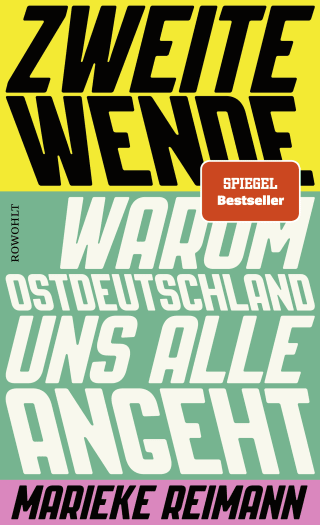
How do wealth and property ownership influence voting behavior? How is the post-reunification era taught in schools? Can Angela Merkel and Tokio Hotel be role models? And why are only West Germans featured in the official images of German Unity Day celebrations?
Renowned journalist Marieke Reimann was born in Rostock in 1987 and grew up with her mother and sister in a prefabricated housing estate. As a child of the post-reunification era, she experienced an East Germany in the 1990s marked by fractured biographies, poverty, and uncertainty. Reimann has lived the challenge of succeeding in West German power circles as a young woman without inherited wealth or established networks, witnessing firsthand how structural inequalities between East and West persist to this day.
In her book, she aims to tell East German stories with authenticity. Too often, she has been confronted with the stereotype of the "complaining, left-behind East German" - her viral commentary for Germany’s flagship news program Tagesthemen was a powerful rebuttal to these clichés. She makes a compelling appeal for a new, genuine interest in one another.
"I wanted to ground the emotionally charged debate in a sober factual basis, made tangible through my own lived experience. Whenever people talk about the East, East German identity is usually reduced to a stereotypical, male, white, and far-right image. I wanted to counter this with facts and lived realities to extend a hand in both directions." Marieke Reimann, in: Brigitte